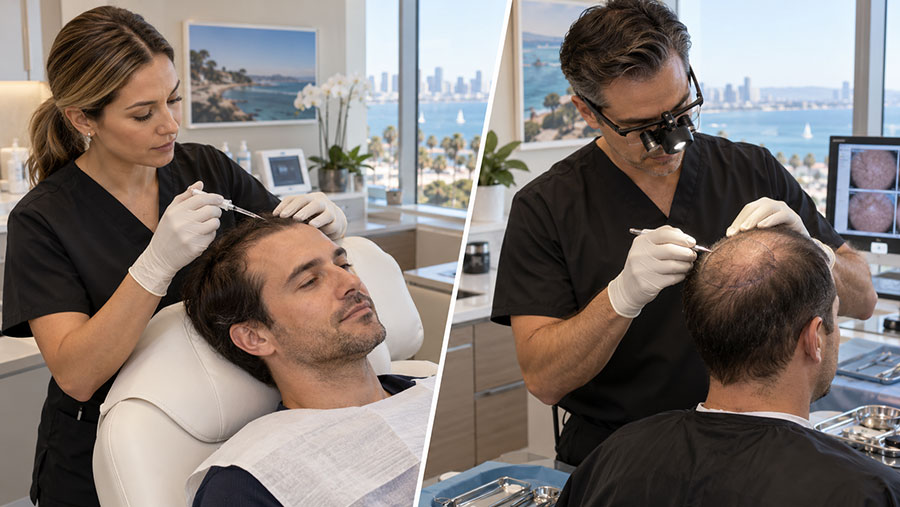
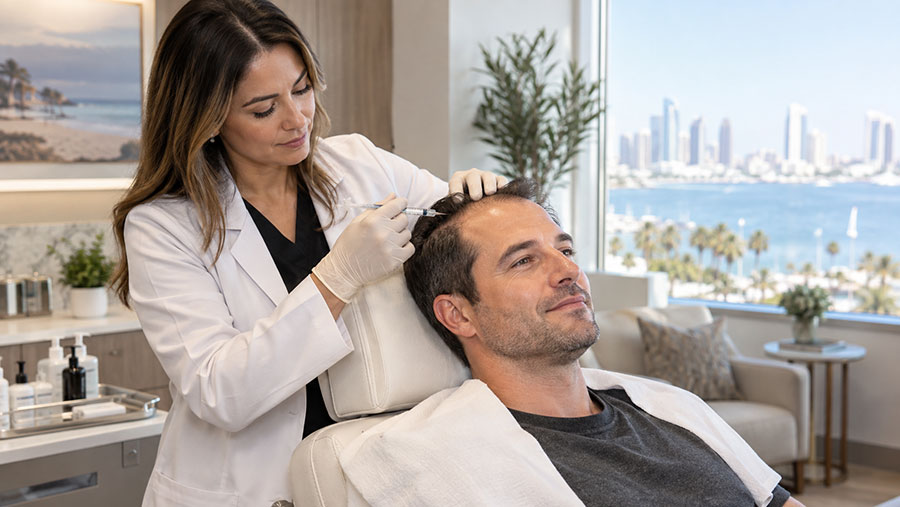
Considering stem cell hair restoration in San Diego? Learn how the treatment is designed to support natural hair growth, who may be a suitable candidate, and what factors can affect results. This guide also covers potential benefits, limitations, safety considerations, and essential questions to discuss with a qualified provider before deciding whether it is right for you.
Stem cell hair restoration sounds promising for thinning hair, but deciding whether it’s right for you depends on your hair loss stage, goals, and safety expectations. Many professionals in San Diego notice early thinning and want a non-surgical, low-downtime option that supports natural-looking results without medications or surgery.
Below, you’ll find how stem cell hair restoration works, who makes a good candidate, how it compares to alternatives like minoxidil and hair transplantation, and what to ask during a consultation. By the end, you’ll have a clearer sense of whether stem cell hair restoration in San Diego aligns with your situation or whether another path makes more sense first.
Key Takeaways
- Stem cell hair restoration in San Diego is a non-surgical, minimally invasive option that works to revitalize dormant follicles with little to no downtime
- Pattern hair loss affects up to 50% of males and females, which makes early evaluation important for treatment success
- Candidacy depends on hair loss stage, scalp health, treatment goals, and willingness to commit to a series of sessions over time
- Treatment alternatives include minoxidil, finasteride, PRP, low-level laser therapy, exosome therapy, hair transplantation, and medical evaluation
- FDA warns that regenerative medicine products generally require approval or clinical trial oversight, so ask providers about product safety and credentials
Stem Cell Hair Restoration Works by Reactivating Dormant Follicles
Stem cell hair restoration is a non-surgical treatment that supports natural restoration of thinning hair by revitalizing dormant follicles and encouraging healthier growth. Regenicel describes this approach as minimally invasive care that aims to improve density and hair quality with little to no downtime.
The treatment creates a supportive environment for follicles rather than replacing them surgically, and results develop gradually as the scalp responds over several months.
Non-Surgical Regenerative Hair Renewal
Non-surgical regenerative hair renewal uses biologics to stimulate dormant follicles and support healthier hair growth. This approach targets the scalp environment rather than relying on medications or surgical relocation of hair.
Regenicel positions stem cell restoration as personalized care for people who prefer minimal disruption to daily routines.
The Role of Exosomes and Follicle Revitalization
Exosomes are cell messengers that support repair and regeneration through scalp and hair follicle signaling. Regenicel describes exosome therapy as a component of regenerative care that encourages cellular communication at the follicle level.
These biologics aim to create conditions for improved follicle function and hair quality over time. The benefits of stem cell hair treatment include supporting density without surgical intervention or daily medication use.
Typical Treatment Process and Timeline Expectations
The typical treatment series includes three sessions spaced approximately one month apart, according to Regenicel. Some early changes may appear within a few months, while fuller results can take 6-12 months, so visible outcomes develop progressively rather than immediately after treatment.
Stem Cell Hair Restoration Candidacy Depends on Stage, Scalp Health, and Goals
Good candidates typically include adults experiencing thinning hair, shedding, or early-stage hair loss who want non-surgical care. Candidacy depends on hair type, goals, and overall scalp health according to Regenicel’s FAQ.
Ideal candidates want natural-looking improvement in hair quality and fullness and accept gradual progress over several months.
Identifying Early Thinning, Shedding, and Pattern Hair Loss
Androgenetic alopecia is pattern hair loss that affects up to 50% of males and females, according to NCBI StatPearls. Male androgenetic alopecia affects 30-50% of men by age 50, according to Endotext/NCBI.
Male-pattern loss often appears at the temples and vertex, while female-pattern loss usually shows as diffuse crown thinning with the frontal hairline preserved. Identifying the pattern early allows timely evaluation of hair loss solutions in San Diego.
Factors Influencing Candidacy: Scalp Health and Goals
Busy professionals who prefer little or no downtime, and people who try over-the-counter options without satisfaction, often make strong candidates. Some clients also ask about stem cell IV infusions for regenerative wellness.
When Stem Cell Hair Restoration May Not Be Suitable
Extra caution is needed for anyone with sudden shedding, patchy hair loss, scalp inflammation, scarring, pain, or symptoms suggesting an underlying medical issue. These individuals should pursue medical evaluation before considering aesthetic treatment decisions.
Caution also applies to people expecting guaranteed regrowth or a cure, and to those with advanced baldness where follicles are no longer viable. Pregnancy, active scalp infection, immunologic issues, cancer history, and medication interactions all require provider clearance first.
| Your situation | Likely fit | Recommended next step |
|---|---|---|
| Early to moderate thinning with viable follicles | Good fit | Book a consultation for a scalp assessment |
| Increased shedding, no scarring or scalp pain | Possible fit | Consultation plus medical history review |
| Sudden, patchy, or painful hair loss | Not yet | Medical evaluation before any aesthetic treatment |
| Advanced baldness or long-standing follicle loss | Unlikely fit | Discuss surgical transplant options |
| Pregnancy, scalp infection, or complex medical history | Needs clearance | Provider clearance before treatment |
Stem Cell Hair Restoration Compared With Medications, Devices, and Surgery
Stem cell hair restoration is one option among several evidence-based and emerging approaches for managing hair loss. Comparing regenerative hair treatment with medications, device-based therapies, and surgical options clarifies which path suits your stage of hair loss.
Each path carries its own benefits, limitations, and candidacy considerations. A consultation matches treatment to your goals and your tolerance for downtime, side effects, and ongoing use.
| Option | How it works | Downtime | Main consideration |
|---|---|---|---|
| Stem cell restoration | Regenerative signals support dormant follicles | Little to none | Series of three sessions; results build over 6-12 months |
| Topical minoxidil | Topical medication for androgenetic alopecia | None | Daily ongoing use; can cause scalp irritation and early shedding |
| Oral finasteride | 5-alpha reductase inhibitor for male pattern loss | None | Prescription only; side effects and contraindications apply |
| PRP | Injections using the patient’s own blood components | Minimal | Multiple sessions plus maintenance over time |
| Low-level laser therapy | Device-based treatment for androgenetic alopecia | None | Requires consistent long-term use |
| Exosome therapy | Cell messengers support scalp and follicle signaling | Minimal | Ask about product sourcing and regulatory status |
| Hair transplant | Surgical relocation of follicles from donor areas | Recovery time needed | Surgery, cost, and donor supply limits coverage |
Minoxidil and Finasteride: Medication Options
Minoxidil is a topical medication developed for androgenetic alopecia in 1987, according to NCBI. Finasteride is an oral 5-alpha reductase inhibitor for male androgenetic alopecia.
Topical minoxidil and oral finasteride are FDA-approved in the United States for male androgenetic alopecia, according to Endotext. One milligram daily finasteride reduces scalp dihydrotestosterone by 64% and serum dihydrotestosterone by 68%, according to Endotext.
PRP, Low-Level Laser Therapy, and Exosome Therapy
Low-level laser therapy is a device-based option for androgenetic alopecia management. PRP involves platelet-rich plasma injections using the patient’s own blood components and may require multiple sessions and maintenance over time.
Exosome therapy, as described by Regenicel, focuses on cell messengers supporting repair and regeneration through scalp and hair follicle signaling. Both PRP and exosomes rely on biologic signaling rather than surgery, which is why they come up together in most consultations.
Hair Transplantation and Medical Evaluation Alternatives
Hair transplant is the surgical relocation of follicles from donor areas to thinning or bald regions. It involves surgery, cost, recovery time, and donor limitations that may affect how much coverage is achievable, so it needs specialist evaluation.
Advanced bald areas or long-standing follicle loss may call for a transplant discussion or medical evaluation rather than a regenerative-only approach.
What to Expect During a Consultation in La Jolla and San Diego
A Regenicel consultation determines fit based on hair type, goals, and scalp health. The provider assesses your hair loss pattern, discusses your expectations, and explains whether a treatment series is appropriate for your situation.
You should expect an honest evaluation of candidacy rather than a guarantee of specific results. The consultation offers an opportunity to ask detailed questions about safety, protocol, and realistic outcomes.
Key Questions to Ask About Product Safety and Protocol
Ask about the source and regulatory status of the stem cell and exosome products used in treatment. FDA states that regenerative medicine products require FDA licensure or approval to be marketed to consumers, and that before approval they require FDA oversight in a clinical trial. Ask how the protocol aligns with that guidance and what adverse-event reporting is in place.
Treatment Sessions, Costs, and Maintenance
Most clients require a series of three treatments typically spaced about one month apart according to Regenicel. Ask about the total cost of the series, what each session includes, and whether maintenance treatments follow. Request a written treatment plan before committing, so the financial and time commitment is clear up front.
Personalizing Your Plan Based on Lifestyle and Risk Tolerance
Your lifestyle and risk tolerance should guide the choice between regenerative care, medications, devices, and surgery. If you value minimal downtime and gradual, natural-looking improvement, stem cell hair restoration may fit your priorities.
If you prefer FDA-approved options with established long-term data, medications like minoxidil or finasteride may be more suitable. You can also contact the clinic with questions about protocol or scheduling before you book.
Safety Considerations and FDA Regulatory Warnings
Safety considerations include the regulatory status of regenerative products and the provider’s credentials. FDA guidance provides important context for evaluating claims and managing expectations.
Knowing potential side effects, contraindications, and when to seek medical evaluation protects your health and your investment. A responsible provider discusses risks openly rather than presenting treatment as risk-free.
FDA Guidance on Regenerative Medicine Products
FDA states regenerative medicine products require FDA licensure or approval to be marketed to consumers. Before approval, regenerative products require FDA oversight in a clinical trial according to FDA guidance.
FDA lists unapproved regenerative products including stem cells, stromal vascular fraction, umbilical cord blood and stem cells, amniotic fluid, Wharton’s jelly, ortho-biologics, and exosomes. FDA reports adverse events from unapproved regenerative products, including blindness, tumor formation, and infections.
Potential Side Effects and Downtime Awareness
Possible mild redness, swelling, or tenderness at the injection site may occur, according to Regenicel. Most people return to normal activities immediately, though individual responses can vary.
Minoxidil can cause scalp irritation and shedding early, according to NCBI and AAD. Finasteride has side effects and contraindications according to Endotext, NCBI, and AAD, which is why every treatment risk belongs in the conversation with your provider.
Importance of Provider Credentials and Proper Evaluation
Verify your provider’s training, credentials, and experience with regenerative hair treatments before proceeding. Reviewing the clinical team behind the practice tells you who performs the treatment and what evaluation protocol they follow.
A qualified provider conducts a scalp examination and medical history review before recommending treatment. Raise any underlying conditions or medications that could affect treatment safety during that visit.
Results Timeline and Long-Term Maintenance
Visible results may appear in 2-3 months on Regenicel’s service page, while their FAQ states average expectations are 6-9 months with full results at 12 months. This timeline reflects the gradual nature of regenerative hair renewal.
Early changes often involve better hair quality and texture, plus reduced shedding, before density gains become noticeable. Knowing that order of events keeps expectations realistic during the waiting period.
| Timeframe | What typically happens |
|---|---|
| Weeks 1 to 4 | Return to normal activities immediately; possible mild redness or tenderness at the injection site |
| Months 1 to 3 | Three sessions completed about a month apart; some clients notice better texture and less shedding |
| Months 3 to 6 | Early density changes may appear as follicles enter active growth phases |
| Months 6 to 12 | Fuller results develop; Regenicel cites average expectations of 6-9 months, with full results at 12 months |
| After 12 months | Provider reviews progress and discusses whether maintenance sessions are worthwhile |
Early Changes Versus Full Results Timeline
Some clients notice early changes within a few months, such as improved hair texture or reduced shedding. Fuller results typically develop over 6-12 months, and the clinic before and after gallery shows what that progression looks like across different starting points.
The timeline varies with individual biology, hair loss severity, and adherence to the series. Judging results too early usually leads to unnecessary disappointment.
The Commitment to Multiple Sessions and Follow-Ups
Completing the full three-session series gives follicles the strongest opportunity to receive adequate regenerative support. Follow-up visits let your provider assess progress and adjust recommendations, and some people benefit from maintenance sessions afterward to sustain improvements.
Managing Expectations for Gradual Hair Renewal
Results vary based on hair loss stage and scalp health, and stem cell restoration supports existing follicles rather than creating new ones. Discussing favorable, typical, and less-favorable scenarios with your provider prepares you for the range of potential results and helps you stay committed through gradual improvement.
Choosing the Right Hair Restoration Path for Your Situation
Matching treatment to your hair loss stage and goals starts with an honest assessment of your current situation. Early thinning responds differently than advanced baldness, and your expectations should align with what each treatment can realistically deliver.
Consider whether you prioritize gradual natural improvement, minimal downtime, or FDA-approved options with long-term data. The decision should reflect both your clinical needs and your own comfort with safety and evidence.
Matching Treatment to Hair Loss Stage and Goals
If you have early-to-moderate thinning with viable follicles, regenerative options like stem cell restoration may support density and quality. Advanced baldness with long-standing follicle loss usually points toward a transplant discussion instead.
Goals matter as much as the stage. Someone seeking subtle improvement in existing hair will approach this differently than someone hoping to restore density in bald areas.
Balancing Natural Results, Downtime, and Safety Concerns
Natural results with minimal downtime appeal to busy professionals, and stem cell hair restoration offers that profile, though results build gradually across a treatment series.
Safety questions should cover product sourcing, regulatory compliance, and adverse-event tracking. Weighing regenerative care against the established evidence base for medications and transplantation is what makes the choice an informed one.
Considering Professional Guidance Versus Over-the-Counter Options
Minoxidil is a topical at-home option that requires ongoing use to maintain results. Over-the-counter products offer convenience and lower cost but not the personalized assessment available through professional care.
Professional guidance allows for customized treatment plans, combination approaches, and monitoring that self-directed care cannot match. Reading client reviews can also show how other people in San Diego describe the consultation and follow-up experience.
Stem Cell Hair Restoration in San Diego: Personalized, Non-Surgical Care for Thinning Hair
Stem cell hair restoration in San Diego offers a non-surgical, low-downtime approach for people experiencing early-to-moderate hair thinning who want regenerative support for natural-looking results. Candidacy depends on your hair loss pattern, scalp health, treatment goals, and willingness to commit to a series of sessions with gradual improvement over 6-12 months.
Comparing stem cell restoration with medications, PRP, laser therapy, exosome therapy, and hair transplantation puts the decision on solid ground. A thorough consultation with a qualified provider tells you honestly whether regenerative care fits your situation or whether another path makes more sense first.
Book Your Consultation With Regenicel Aesthetics in La Jolla
Regenicel Aesthetics provides regenerative hair treatments for La Jolla and San Diego clients who want personalized, science-forward care. The team reviews your hair loss pattern, scalp health, and goals, then says plainly whether a treatment series fits or whether medical evaluation should come first.
Call +1 858-758-1573 or request your complimentary consultation and treatment quote to receive a written plan covering session count, timing, and cost before you commit. Regenicel Aesthetics is located at La Jolla Wellness Center, 8950 Villa La Jolla Drive, Suite B115, La Jolla, California 92037, and you can email info@regenicel.com with any questions.
Frequently Asked Questions About Stem Cell Hair Restoration in San Diego
Regenicel Aesthetics reports possible mild redness, swelling, or tenderness at the injection site, with most people returning to normal activities immediately. Safety also depends on the product used, because the FDA states that regenerative medicine products require licensure or approval and has linked unapproved products to adverse events, including infections. Ask where the biologics come from and how adverse events are tracked. Pregnancy, active scalp infection, immunologic issues, or a complex medical history all require provider clearance first.
Cost depends on the number of sessions in your plan, since most clients complete a series of three treatments spaced about a month apart, plus any maintenance that follows. Ask for the total cost of the series in writing rather than a single-session price, and confirm what each visit includes. Regenicel offers a complimentary consultation, so you can get that quote before committing.
Most clients complete three sessions spaced approximately one month apart. Some people notice early changes such as improved texture or reduced shedding within a few months. Regenicel’s service page points to visible results in 2-3 months, while their FAQ cites average expectations of 6-9 months with full results at 12 months.
Pattern hair loss affects up to 50% of males and females according to NCBI StatPearls, and women are candidates on the same terms as men. Female-pattern loss often shows as diffuse crown thinning with the frontal hairline preserved, a pattern that still has viable follicles to support. Candidacy depends on hair loss stage, scalp health, and goals rather than gender.
PRP uses platelet-rich plasma prepared from the patient’s own blood and typically requires multiple sessions plus ongoing maintenance. Stem cell hair restoration uses regenerative biologics that deliver signals intended to reactivate dormant follicles and support scalp health. Both are non-surgical, involve minimal downtime, and build results gradually. The practical difference is the material used, which is why product sourcing belongs in your consultation.