Stem cell hair restoration questions matter more than most patients expect. Regenerative hair treatment draws people who want non-surgical renewal without transplant downtime, and the marketing moves faster than the science. How a clinic answers a direct question tells you how it will handle your care.
Below, you will find 10 questions covering candidacy, regulatory status, full costs, timelines, credentials, evidence, risks, and follow-up. Bring them to your consultation. They separate clinics that answer transparently from clinics that lean on unsupported claims, whether you are weighing stem cell hair restoration or another option.
Key Takeaways
- A consultation should begin with diagnosis and candidacy assessment, because hair loss has multiple causes and no single treatment works for everyone.
- Most patients require three treatments spaced about one month apart, so evaluate pricing as a full treatment plan rather than a single session.
- Expected timelines are gradual: early visible changes may take a few months, average results appear at 6-9 months, and full results develop over 12 months.
- The FDA cautions patients about unapproved regenerative medicine products and requires many regenerative therapies to undergo clinical trial oversight before approval.
- Credible clinic vetting covers provider credentials, exact product and protocol identity, known risks, aftercare requirements, result tracking, and a clear follow-up plan.
Stem Cell Hair Restoration Questions About How the Treatment Works
Stem cell hair restoration uses regenerative materials to support dormant follicles and encourage healthier growth in areas affected by thinning. It differs from hair transplant surgery by avoiding incisions, grafts, and extended recovery.
The aim is better hair quality, density, and scalp health through cellular signaling rather than surgical relocation. Knowing what to ask a doctor before treatment gets you clear answers on the procedure, the product source, and your own hair-loss pattern.
Regenerative Materials Used in Treatment
The FDA counts stem cells, exosomes, stromal vascular fraction, umbilical cord blood, amniotic fluid, and Wharton’s jelly as regenerative medicine products. Regenicel uses exosomes derived from stem cells to support follicle revitalization. Ask your clinic to name the exact material, say whether it is autologous, donor-derived, or laboratory-prepared, and explain how sterility is verified.
How Stem Cells and Exosomes Support Hair Renewal
Stem cells release signaling molecules called exosomes that carry repair instructions to surrounding cells. These exosomes may help reactivate dormant follicles, improve scalp blood flow, and support the growth phase of the hair cycle. Pre-procedure counseling for stem cells should cover how cellular signaling differs from topical medications and what evidence supports it for your condition.
Differences Between This Approach and Traditional Hair Restoration
Traditional options include minoxidil, finasteride, laser devices, PRP injections, microneedling, corticosteroid injections, and surgical transplants. Stem cell Biologiccs hair restoration is non-surgical with minimal downtime, letting clients return to regular activities right after treatment with no recovery period required.
PRP draws your blood, separates it, and injects plasma into the thinning area, while stem-cell-based protocols use laboratory-prepared exosomes or cells. Ask how the recommendation compares and whether combining therapies helps.
Stem Cell Hair Restoration Questions About Candidacy and Diagnosis
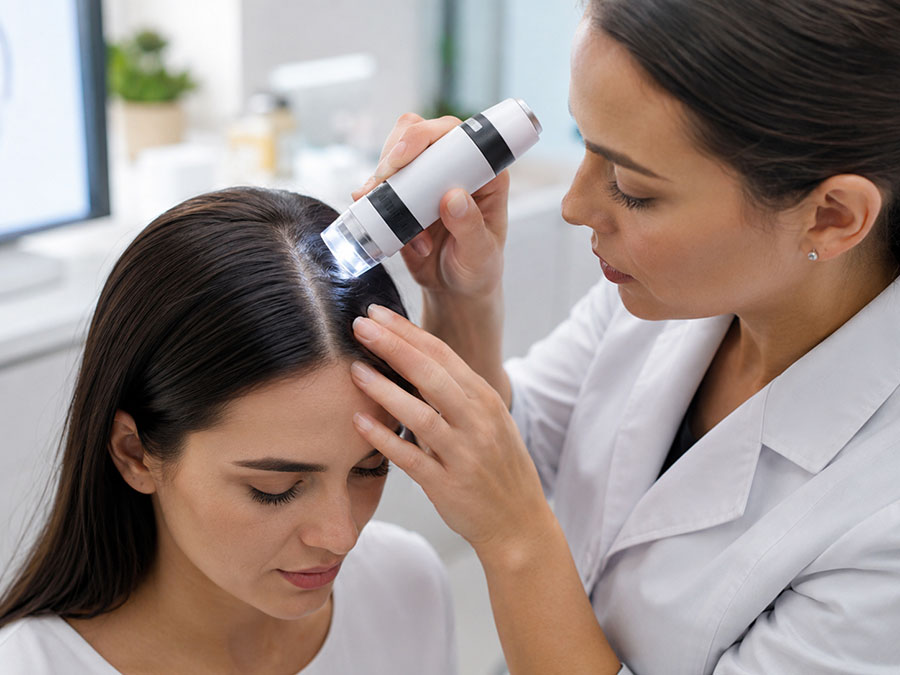
Clinics should evaluate you before recommending treatment, confirming that your hair-loss type and stage are appropriate. That usually means a scalp examination, medical history review, a conversation about expectations, and sometimes tests that rule out underlying conditions.
No single hair-loss treatment works for everyone, so candidacy screening protects you from paying for a protocol unlikely to address your cause of thinning. A credible clinic will explain their assessment process and say when another treatment fits you better.
Diagnostic Methods That Identify Hair Loss Causes
Dermatologists may order blood tests or a scalp biopsy when they suspect disease, vitamin deficiency, hormone imbalance, or infection. These separate androgenetic alopecia from autoimmune, nutritional, or inflammatory causes that need different treatment. Ask whether your consultation includes lab work, magnified scalp examination, or pull tests. A clinic that skips diagnosis may not be putting your interests first.
Hair-Loss Stage and Severity Assessment
Severity ranges from early thinning to advanced pattern baldness, and clinics may use the Norwood scale for men or the Ludwig scale for women to document your stage. Your provider should photograph your scalp from several angles and mark active thinning versus stable hair. That baseline is the only objective way to judge improvement later.
Medical History and Expectation Review
The consultation sets the plan and lets the provider review medications, allergies, previous treatments, goals, timeline, and alternatives. Ask whether a licensed medical professional performs the evaluation or administrative staff do. A patient FAQ on stem cell therapy should state who makes the final candidacy call and whether the clinic will decline an unsuitable case.
Regulatory Status and Safety Records Deserve Direct Answers
Regulatory status separates FDA-approved therapies from investigational protocols and unapproved products marketed outside clinical trial oversight. The FDA requires regenerative medicine products intended to treat or cure disease to be licensed or approved before they are marketed to consumers.
Before approval, such products require FDA oversight in a clinical trial establishing safety and effectiveness. RMAT designation is a formal FDA classification tied to investigational new drug applications, not a phrase clinics may use freely. Our FAQ page covers these points in plain language.
FDA Approval and Clinical Trial Oversight
Ask whether the product is FDA-approved, FDA-cleared, used under an investigational protocol, or offered outside FDA approval. The distinction affects oversight, safety monitoring, and the evidence behind the treatment. A provider who cannot explain sourcing, manufacturing standards, and classification has answered a different question about transparency.
Known Side Effects and Risks
Mild redness, swelling, or tenderness at the injection site may occur and usually settles within hours to a few days. The FDA has received reports of blindness, tumor formation, infections, and other serious complications tied to unapproved regenerative products. Hair transplant surgery carries its own risks, including infection, scarring, failed grafts, and anesthesia reaction. Ask for adverse events in writing and how complications are monitored.
Sterile Technique and Patient Safety Protocols
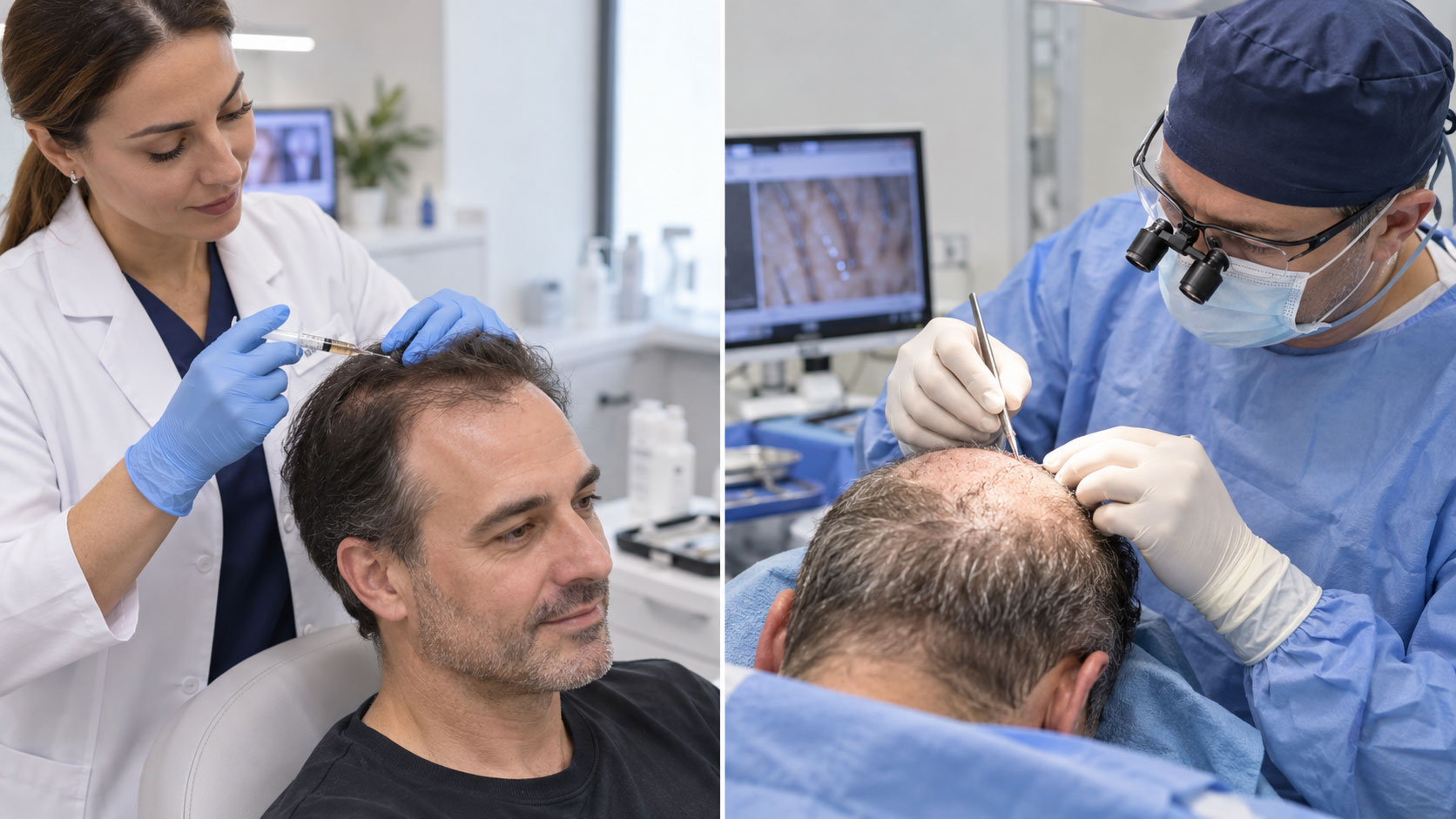
Because material is injected into the scalp, aseptic technique prevents infection and contamination. Your provider should explain sterilization of equipment, workspace preparation, and injection technique. Ask what happens if you develop signs of infection, and confirm the clinic has emergency protocols and medical supervision on hand.
Treatment Plans Run Three Sessions Across Several Months
Most clients require three treatments spaced about one month apart. Understanding the timeline lets you plan your schedule, budget, and expectations before the first session.
Results develop gradually as follicles respond and move through natural growth cycles. Your provider should set out session dates, follow-up assessments, and how long to wait before judging effectiveness. You can book a consultation to see that schedule mapped to your case.
| Stage | What patients may notice | What to confirm with the clinic |
|---|---|---|
| Sessions 1 to 3, about a month apart | Limited visible change; shedding may continue | That all three sessions are booked and priced upfront |
| 2 to 3 months after session 1 | Some report reduced shedding or improved texture | The date of the first progress photo review |
| 6 to 9 months | Average point at which results are reported | How improvement is measured objectively |
| 12 months | Full result assessed against baseline photos | Whether maintenance sessions are recommended |
Session Count and Treatment Intervals
Three sessions roughly four weeks apart is standard at many clinics, though your plan may differ with severity and response. Ask whether the quote covers all sessions or only the first, and how the protocol changes if the first session underperforms.
Early and Full Result Timelines
Ask your provider to define results specifically: reduced shedding, improved texture, increased density, or visible fullness. Clinical response to approved therapies may also take 6-12 months, and many people see some regrowth with minoxidil in that window. Request follow-up photos so progress is tracked against a baseline, not memory.
Follow-Up and Maintenance Protocols
Minoxidil and finasteride require continuous use to hold their effect, and regenerative treatments may also need periodic maintenance. Ask whether follow-up visits and progress photography are included in the package price or are billed separately.
Total Cost Depends on Sessions, Materials, and Follow-Up
Total cost reflects consultation findings, the number of sessions, the materials used, and maintenance requirements. Treating stem cell hair restoration as a complete plan rather than a single-session expense prevents surprise costs and makes comparisons accurate.
Transparent clinics itemize consultation fees, per-session charges, product costs, follow-up visits, and add-on therapies in a written estimate. Ask for that breakdown before you commit, or contact the clinic and request it in writing.
| Cost item | Question to ask | Why it matters |
|---|---|---|
| Consultation fee | Is it credited toward treatment if I proceed? | Decides whether vetting several clinics carries real cost |
| Per-session or package | Does the quote cover all three sessions? | A low single-session price can produce a higher total |
| Product and materials | Are exosome or cell material costs included? | Often the largest line on the estimate |
| Follow-up visits | Are progress reviews and photos billed separately? | Follow-up is where results are actually measured |
| Aftercare products | Are topicals or supplements required and priced in? | Add-ons can change the total significantly |
| Refunds and retreatment | What applies if results fall short? | Sets expectations before payment rather than after |
Per-Session Pricing versus Package Pricing
Some clinics charge per session; others price all three treatments as a package. Ask which applies, whether the package covers follow-up visits and progress photos, and whether your consultation fee counts toward treatment.
Consultation Fees, Follow-Up Visits, and Aftercare Coverage
Confirm whether the price covers the initial consultation, baseline photography, follow-up assessments, post-treatment instructions, and provider access for questions. Check supplies too, including topical aftercare and supplements. Hidden costs erode an attractive headline price.
Refund, Cancellation, and Retreatment Policies
Reputable clinics explain cancellation terms, refund policy, and what happens if you do not achieve expected results after the full series. Get these in writing before signing or paying. A clinic that refuses to discuss them may lack confidence in its results.
Provider Credentials Determine Safety and Injection Quality
Credentials, training, and experience affect both the safety and the outcome of your treatment. Ask for specifics: medical license, training in regenerative hair restoration, years of experience, and procedure volume.
Request this during your consultation when it is not published. Reviewing the clinic’s transparency about its team shows whether qualified professionals will perform and supervise your care.
Provider Training and Experience in Regenerative Hair Restoration
Ask whether a physician, nurse practitioner, physician assistant, or aesthetician performs the procedure, what regenerative training they completed, and whether their license is active and unrestricted. Ask how many procedures they have performed. Injection technique, depth, and placement come from repetition.
Responsibility for Complications and Adverse Reactions
Clarify who monitors you during and after treatment, and who to contact if problems appear later. Ask whether a physician is on-site or on-call to manage complications. A clinic that cannot answer may lack the infrastructure to support patient safety.
Supervision and Medical Oversight
Ask whether a licensed physician supervises the protocol, reviews candidacy, and signs off on your plan even when a non-physician injects. Confirm that the physician can review your case and adjust the protocol. Supervision separates medical-grade care from cosmetic services run without clinical governance.
Evidence Should Match Your Specific Hair-Loss Diagnosis
Clinical research and case studies help establish whether an approach suits a specific type of hair loss, and studies show PRP can be safe and effective. Because no one treatment works for everyone, evidence only means something against your own diagnosis.
Ask what research supports the protocol for your pattern and whether published studies included similar patients. Patient reviews and published evidence serve different purposes, and a credible clinic will point you to both.
Clinical Research and Case Studies Behind the Approach
Request peer-reviewed studies, trials, or case reports relevant to your hair loss, and ask whether the clinic tracks outcomes internally. Be cautious when a provider cites no research and relies on testimonials. Credible clinics acknowledge both the evidence and its limits.
Comparison With FDA-Approved Options Like Minoxidil and Finasteride
Topical minoxidil and oral finasteride are FDA-approved for male androgenetic alopecia. They prevent further loss, only partially reverse baldness, and require continuous use. Androgenetic alopecia affects 30-50% of men by age 50, the most common form of hair loss with approved treatments available.
| Option | Regulatory status | Time before judging results | Ongoing use needed |
|---|---|---|---|
| Topical minoxidil | FDA-approved for androgenetic alopecia | 6-12 months | Yes, continuous |
| Oral finasteride | FDA-approved for male androgenetic alopecia | 6-12 months | Yes, continuous |
| PRP injections | Blood-derived, prepared in office | 3-6 months, varies | Periodic maintenance |
| Exosome or stem cell protocols | Ask the clinic to state the exact status | 6-12 months | Maintenance may be advised |
| Hair transplant surgery | Surgical procedure | 9-12 months | No, but carries surgical risk |
Realistic Expectations for Individual Outcomes
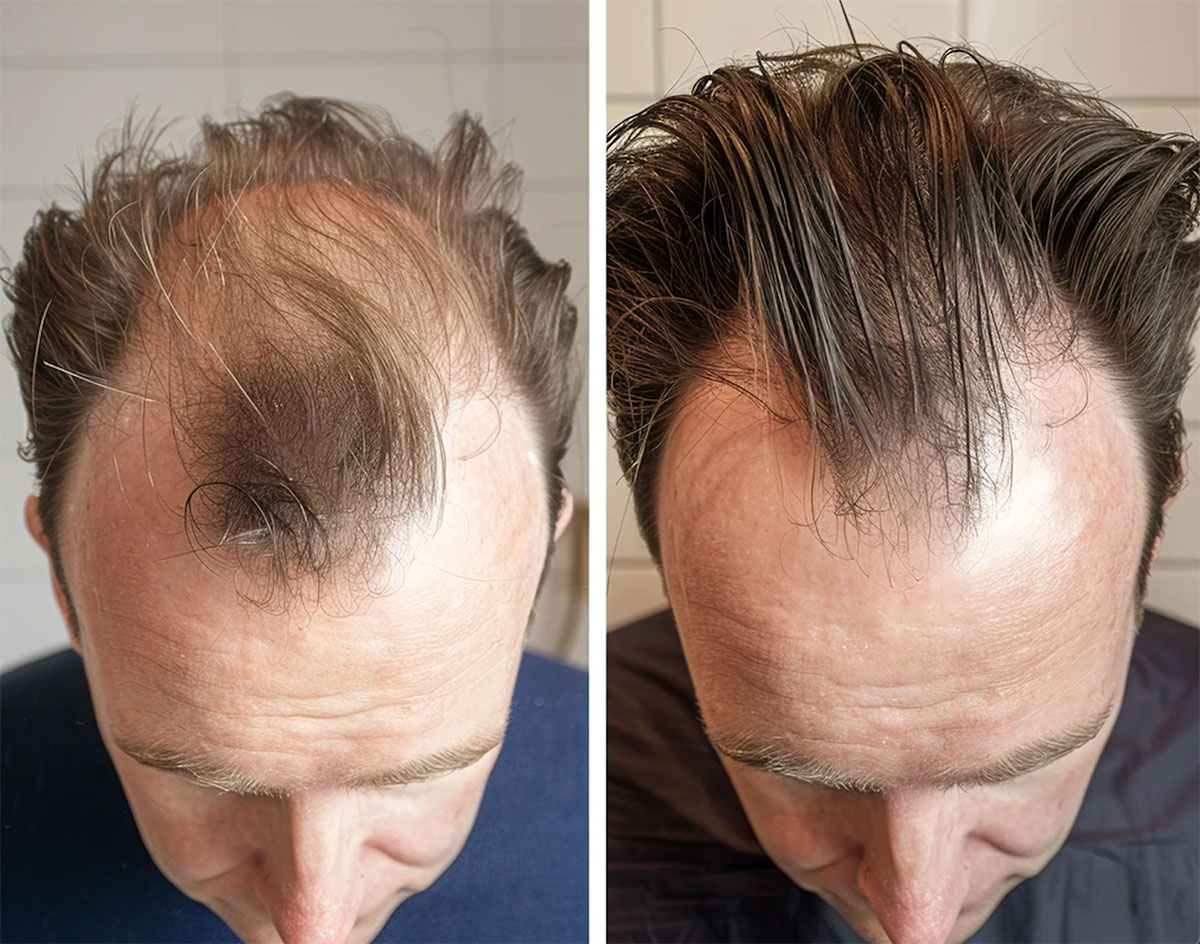
Your provider should say plainly that response varies, that some people improve significantly while others see minimal change. Ask what share of patients report noticeable results and what happens if you do not respond. Promises of guaranteed regrowth overstate what the treatment can do.
Using These Questions to Compare Clinics Objectively
These 10 questions form a framework for judging whether a clinic values transparency, patient safety, and realistic expectations over aggressive marketing. Documenting the answers you receive at each consultation lets you compare providers and spot inconsistencies.
Strong clinics welcome detailed questions, put protocols and pricing in writing, and acknowledge both benefits and limits. If a provider dismisses your concerns, rushes you to book, or cannot answer basic questions about product identity and FDA status, keep looking.
| # | Question to ask | A reassuring answer | A warning sign |
|---|---|---|---|
| 1 | Am I a candidate, and how did you decide? | Explains the diagnosis, scale used, and fit | Recommends treatment before any examination |
| 2 | What exact product will you use? | Names material, source, preparation | Vague talk of stem cells with no specifics |
| 3 | What is the FDA status of that product? | States the classification plainly | Claims approval without documentation |
| 4 | What are the known risks? | Adverse events listed in writing | Says there are no risks at all |
| 5 | How many sessions, and how far apart? | A defined series with dates | Leaves the number open-ended |
| 6 | When should I judge results? | 6-9 months average, 12 months for full | Promises visible results in weeks |
| 7 | What is the total cost, itemized? | Written estimate covering every line | One number with no breakdown |
| 8 | Who performs the injections? | Named provider, license, training | Declines to say who will treat you |
| 9 | What evidence supports this for my case? | Cites studies and outcome tracking | Offers testimonials only |
| 10 | What does follow-up include? | Scheduled reviews, photos, contact | No follow-up plan mentioned |
Stem cell hair restoration offers a non-surgical option for natural-looking hair renewal, and the outcome depends on accurate diagnosis, appropriate candidacy, qualified providers, and expectations grounded in evidence. Regenicel emphasizes personalized consultation, therapies intended to support dormant follicles, and timelines that acknowledge how gradually regrowth happens.
Ask Regenicel Aesthetics These Questions in La Jolla
Regenicel Aesthetics treats hair loss non-surgically from the La Jolla Wellness Center, serving La Jolla, San Diego, and the surrounding coastal communities. Every case starts with a complimentary consultation covering candidacy, product identity, the treatment schedule, and itemized pricing before anything is booked. Services include Stem Cell Restoration, Exosome Therapy, and Stem Cell Biologics IV infusions guided by specialists focused on safety and natural-looking results.
Call +1 858-758-1573 or request your personalized treatment quote online. Bring the 10 questions from this article to your consultation, and we will answer every one of them in writing.
Frequently Asked Questions
Total cost depends on the number of sessions, the regenerative material used, and whether follow-up visits are bundled in. Most plans involve three sessions about a month apart, so a single-session figure tells you very little. Ask for a written estimate itemizing consultation, sessions, materials, follow-up reviews, and aftercare. A clinic that will not produce that breakdown cannot be compared fairly.
The FDA requires regenerative medicine products intended to treat or cure disease to be licensed or approved before marketing, and many hair protocols are not approved in that sense. Before approval, such products are expected to undergo FDA oversight through a clinical trial. Ask any clinic to state whether its product is FDA-approved, FDA-cleared, investigational, or offered outside approval. A provider who avoids that question has told you something useful.
Results develop gradually as follicles respond and move through natural growth cycles. Some patients report early changes within a few months, average results appear around 6-9 months, and full results are usually assessed at 12 months after the series. Response varies between individuals, which is why baseline photography matters. Ask your provider to define what counts as a result before you begin.
A licensed medical professional trained in regenerative hair treatment should perform the injections, with a physician supervising the protocol and the candidacy decision. Ask for license status, training, years of experience, and procedures performed. Confirm who monitors you for adverse reactions and who to contact afterward. Injection depth and placement affect safety and outcome, so experience matters.
The two approaches work differently. A transplant surgically relocates follicles and carries risks including infection, scarring, failed grafts, and anesthesia reaction, while regenerative treatment is non-surgical and aims to support follicles already present. Candidacy differs: transplants suit advanced pattern loss with a viable donor area, while regenerative protocols are generally discussed for earlier thinning. Ask a provider who offers both which option fits your diagnosis.