How much does stem cell hair restoration cost in San Diego? Explore the key factors that may affect pricing, including the extent of hair loss, treatment technique, number of sessions, clinic expertise, and personalized care. This guide explains what may be included in your estimate and what to ask during a consultation before comparing treatment options.
Stem cell hair restoration cost in San Diego is set by the treatment plan, not by a published price list. Protocols change with the severity and pattern of thinning, the size of the treatment area, the biologic product used, and the number of sessions recommended. Clinics that offer stem cell hair restoration assess hair and scalp condition during a consultation before quoting a total, so the figure reflects the care each patient actually needs.
Below, you’ll find the cost drivers that San Diego patients ask about, how a quote is put together, what a session series looks like, and how regenerative treatment compares with PRP and surgical transplants. We also cover the questions worth asking, so clinics can be compared on care standards rather than price.
Key Takeaways
- Stem cell hair restoration cost in San Diego is quoted after a complimentary consultation rather than published as a fixed price
- Most clients complete a series of three treatments spaced about one month apart
- Results build over 6 to 12 months as the natural hair growth cycle responds
- Pricing moves with hair loss severity, treatment area size, product choice, and session count
- Verify provider credentials, product sourcing, FDA status, and progress tracking before starting treatment
Stem Cell Hair Restoration Cost in San Diego Starts With the Treatment Itself
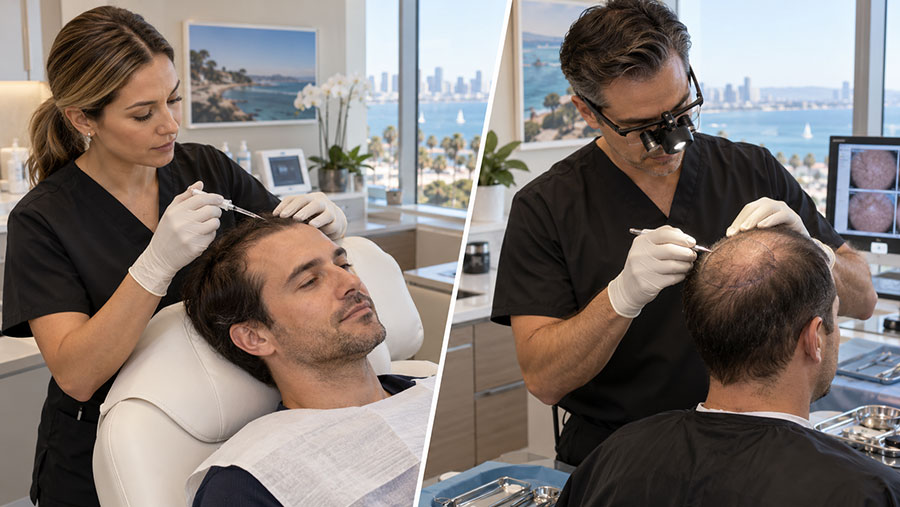
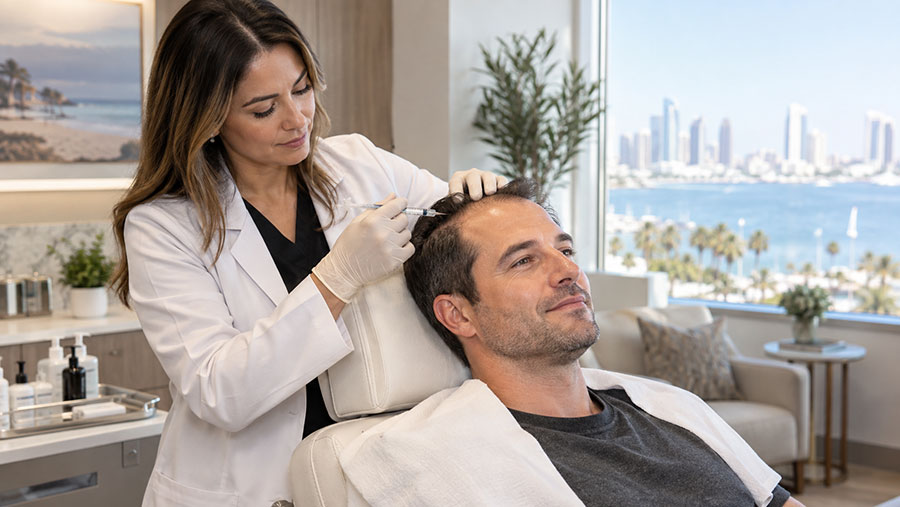
Stem cell hair restoration uses biologic products derived from stem cells to stimulate dormant follicles and support natural regrowth. These stem cell-derived therapies deliver growth factors and signaling molecules into the scalp during brief in-office injection sessions, and results build gradually as the hair growth cycle responds. Protocols differ, including exosome-based treatments, and product choice shapes both the protocol and the cost structure.
Types of Regenerative Therapies Offered
Regenerative hair restoration covers platelet-rich plasma therapy, stem cell-derived preparations, and exosome-based protocols. PRP uses the patient’s own blood to concentrate platelets and growth factors for injection, while exosome therapy isolates extracellular vesicles derived from stem cells to deliver regenerative signals without live cells.
| Regenerative option | What is delivered | Effect on cost |
|---|---|---|
| PRP therapy | Concentrated platelets and growth factors from the patient’s own blood | Lower per session; the sample is processed in office |
| Stem cell-derived preparations | Growth factors and nutrients from prepared biologic products | Mid to higher range, depending on sourcing and volume |
| Exosome-based protocols | Extracellular vesicles carrying proteins, growth factors, and RNA | Usually the highest per session; isolation is more complex |
| Combination protocols | Two or more of the above layered into one plan | Priced by the number of sessions and products used |
The choice depends on hair loss pattern, scalp health, and goals. Some clinics adjust biologic preparations after the scalp assessment, which affects both the timeline and the price of stem cell therapy for hair loss.
How Regenerative Treatment Differs From PRP and Surgical Transplants
Regenerative therapies stimulate existing follicles using biologic signals, while surgical transplants relocate hair-bearing grafts. FUE (Follicular Unit Extraction) and FUT (Follicular Unit Transplantation) remove and place follicles or strips of scalp tissue, and FUE is newer, less invasive, and quicker to recover from. PRP sits closer to stem cell treatment but uses the patient’s own platelets, and both reactivate follicles where they already sit.
Stem Cell Hair Restoration Cost in San Diego Is Quoted After a Consultation
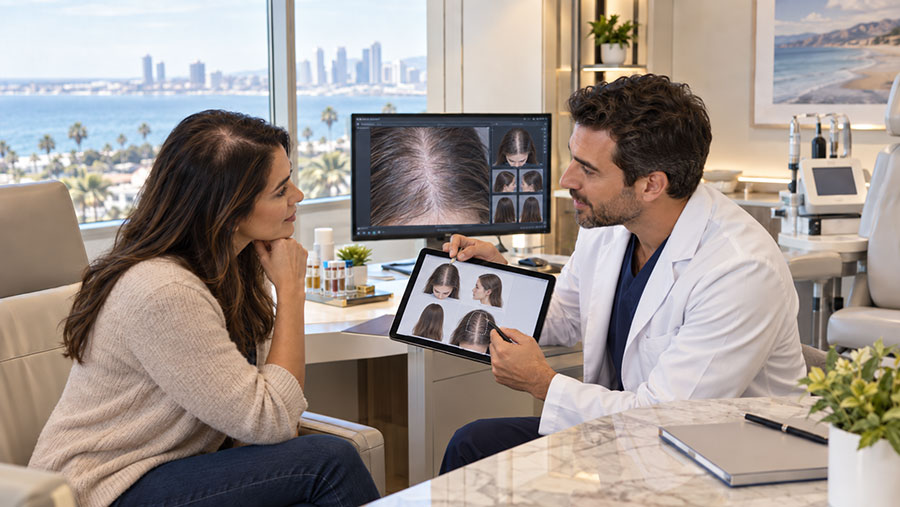
Providers build personalized plans because hair loss severity, pattern, and scalp condition vary widely. A full scalp assessment sets treatment area size, session count, and product selection, and fixed pricing cannot account for those variables. The provider evaluates hair density, follicle health, scalp inflammation, and the extent of miniaturization, then builds the protocol around each patient’s goals. Consultation-based pricing lets the quote include the sessions, follow-up appointments, and maintenance a patient needs.
Items Included in a Treatment Quote
A complete quote covers the initial consultation, scalp analysis, the recommended sessions, and follow-up evaluations. Stem cell-derived and exosome-based protocols may be quoted differently from PRP depending on provider, treatment area, product, and follow-up plan, so confirm whether it covers a full series or one session.
| Quote component | What to confirm before agreeing |
|---|---|
| Consultation and scalp analysis | Whether it is complimentary and what imaging or microscopy is used |
| Treatment sessions | How many sessions the price covers and the fee for any added session |
| Biologic product | Which product is used, how it is sourced, and how volume is decided |
| In-session care | Scalp preparation, numbing agents, and post-treatment instructions |
| Follow-up evaluations | Which check-ins are included and how progress is documented |
| Maintenance injections | Whether they are bundled into the quote or billed separately later |
Number of Treatment Sessions Usually Recommended
Most clients complete three treatments spaced about one month apart, which gives the hair growth cycle time to respond before the next session. Patients with advanced loss or larger treatment areas may need more, and providers adjust the count based on scalp response. Total sessions drive the average stem cell treatment fees, so settle the expected series length at consultation.
Timelines for Results and Follow-Up
Results may begin within a few months, with an average expectation of 6 to 9 months and full results at 12 months. The growth cycle includes resting, shedding, and growth phases that take time to respond after regenerative stimulation, and maintenance injections may be needed every 3 to 6 months to maintain the improvement.
| Stage | What patients can expect |
|---|---|
| Weeks 1 to 4 | No downtime; normal activities resume the same day |
| Months 2 to 3 | Early changes in hair quality and reduced shedding for some patients |
| Months 6 to 9 | Average window for visible gains in density and hair caliber |
| Month 12 | Full results assessed against baseline photography and scalp measurements |
| Every 3 to 6 months | Maintenance injections considered to sustain improvement |
Cost Factors That Shape a San Diego Treatment Plan
Several factors drive the total, including the degree of hair loss, treatment area size, and biologic product. San Diego providers also price against facility standards, product sourcing, and the level of individual care, so expect a consultation-based quote rather than a standard rate.
| Cost driver | Why it changes the quote |
|---|---|
| Hair loss severity | More extensive thinning needs more biologic product and more injection sites |
| Treatment area | Crown, hairline, or full scalp coverage changes session length and volume |
| Biologic product | PRP, stem cell-derived preparations, and exosomes carry different costs |
| Session count | Three sessions is common; advanced cases may need more |
| Provider credentials | Training, clinical oversight, and hair restoration experience |
| Facility standards | Sterile processing, medical-grade equipment, and regulatory compliance |
| Maintenance plan | Ongoing injections add to the multi-year investment |
Higher-concentration products and advanced processing raise the per-session fee, and a combination protocol adds further variability. These drivers show whether a quoted price reflects appropriate care standards.
Severity and Pattern of Hair Loss
Extensive thinning across large areas requires more biologic products and longer sessions than isolated patches, since injection sites increase with the treatment area. Hair-loss treatment pricing depends on location and other factors and is usually not covered by insurance, so the out-of-pocket cost is significant. Pattern matters as well. Diffuse thinning, a receding hairline, and crown balding each change injection strategy and volume, while early-stage thinning may reach its goal with fewer sessions.
Provider Credentials and Clinic Standards
Credentials, training, and experience influence both safety and results, and clinics that invest in product sourcing, sterile processing, and ongoing education may price higher to reflect those standards. Regenicel’s team emphasizes personalized care and clear communication about realistic outcomes and timelines rather than sales pressure. Patients should expect any provider to explain the biologic product, the processing method, and the evidence behind it.
Choice of Treatment Product
The product selected, whether PRP, stem cell-derived exosomes, or another regenerative preparation, affects both per-session and total cost. Exosome-based therapies often carry higher fees than PRP because processing and isolation are more involved, and sourcing, quality control, and growth factor concentration account for much of the rest. Proprietary or third-party products also carry licensing and handling costs that reach the patient.
Clinic Vetting Steps for San Diego Patients
San Diego patients should verify credentials, ask detailed questions about biologic products, and request clarity on how success is measured. A reputable clinic explains its protocol, gives realistic timelines, and assesses candidacy honestly; reviews and patient feedback show how a clinic communicates and follows up. Confirm it meets regulatory and safety standards for regenerative medicine products, and treat any clinic that sidesteps questions about sourcing or outcomes as a red flag.
Questions to Ask About Products and Procedures
Ask what biologic product is injected, where it is sourced, and how it is processed. Questions about FDA approval status, safety data, and whether the treatment is investigational clarify the clinical framework, while expected volume per session indicates the scope of treatment. Ask which side effects are common, what happens if a patient does not respond, and whether alternatives are offered. Providers who deflect questions or push for a same-day commitment are worth avoiding.
Credentials and Experience to Look For
Providers should have documented training in injection technique, scalp anatomy, and regenerative medicine protocols, and board certification in a relevant specialty shows a foundation in hair loss physiology. Ask how long the provider has performed regenerative hair treatments and how many patients they have treated. Clinics should also disclose whether injections are performed by a physician, nurse practitioner, or physician assistant, and who supervises. Detailed FAQs about protocols and staff qualifications help patients assess expertise before the consultation.
How Treatment Success Is Measured
Progress is tracked over 6 to 12 months using standardized before-and-after photography, scalp density assessments, and patient-reported change. Some clinics use digital imaging to measure hair caliber, follicle count, and coverage at baseline and at each follow-up. Clinics that offer no structured follow-up or fail to document progress raise accountability concerns.
Cost Comparison With PRP Therapy and Surgical Hair Transplants
Regenerative therapies spread cost across a series of sessions, while surgical transplants usually involve a single upfront fee. PRP therapy ranges from $500 to $2,500 per session, though that range does not reflect stem cell-derived or exosome-based protocols. A 2019 systematic review of PRP for hair loss analyzed 11 papers with 262 participants and found wide variability in preparation methods and outcomes. Another 2019 review of 19 studies and 460 people found most reported regrowth, again with significant protocol differences.
| Factor | Regenerative treatment | PRP therapy | Surgical transplant |
|---|---|---|---|
| Cost structure | Series of sessions, quoted after consultation | Per session, commonly $500 to $2,500 | Single upfront fee, thousands to tens of thousands |
| Procedure | Targeted scalp injections | Targeted scalp injections | Incisions and graft placement (FUE or FUT) |
| Downtime | None; same-day return to activity | Minimal | Recovery period while the scalp heals |
| Result timeline | 6 to 12 months | Several months | Months, after transplanted follicles shed and regrow |
| Maintenance | Injections every 3 to 6 months may be advised | Repeat sessions are typical | Relocated follicles keep growing while donor hair stays healthy |
The comparison between a hair transplant and stem cell treatment depends on the grafts needed versus the number of regenerative sessions required for similar density. Surgical transplants may run from several thousand to tens of thousands.
Differences in Procedure, Downtime, and Results
Regenerative hair restoration is a series of treatments with little to no downtime, so patients return to regular activities the same day. Surgical transplants involve incisions, graft placement, and a healing period, and while FUE recovers faster than FUT, both disrupt daily life more than injections do. Regenerative results develop over 6 to 12 months and may need maintenance, while transplanted follicles shed before regrowing and then keep growing while donor-site hair stays healthy.
Candidates Suited to Non-Surgical Regenerative Treatment
Non-surgical regenerative treatment suits patients with early-to-moderate diffuse thinning who want to preserve and strengthen the follicles they still have, and those who prioritize minimal downtime and no surgical scars. Advanced hair loss with large bald areas may see more dramatic change from surgical transplantation. Eyebrow and beard restoration can follow regenerative protocols when transplants are not wanted. Strong candidates hold realistic expectations and commit to the full treatment series.
La Jolla and San Diego as a Center for Regenerative Hair Care
La Jolla and San Diego draw patients who want science-backed regenerative treatment inside a wellness-oriented community, and the area’s concentration of medical research institutions creates a competitive market for advanced aesthetic care. Local schedules and climate make a long surgical recovery less appealing, so non-invasive treatment that fits around work and social life tends to win out.
How Regenicel Positions Its Services Locally
Regenicel emphasizes non-surgical protocols, comfortable sessions, little to no downtime, and plans built around the individual, with a focus on visible improvement over months rather than instant growth. Regenicel Aesthetics sits inside the La Jolla Wellness Center at 8950 Villa La Jolla, Suite B115, La Jolla, CA 92037, and patients can reach the clinic at +1 858-758-1573 or at info@regenicel.com. A complimentary consultation and personalized treatment plan come first, giving patients a scalp assessment and a clear view of the protocol before any financial commitment.
Patient Priorities When Choosing a Clinic
San Diego patients look for transparent pricing, realistic timelines, and clear explanations of the biologic products used, along with scheduling that works around their commitments. Safety, regulatory compliance, and evidence-based protocols rank high in a market where claims vary widely. Clinics that answer plainly about sourcing and data and track progress objectively earn trust.
Common Buyer Questions to Settle Before Treatment
Patients commonly ask why pricing is not published online, what FDA approval status applies, and how long results take. Concerns about safety, side effects, and the possibility of non-response belong in the consultation, together with insurance coverage, payment plans, and whether maintenance continues indefinitely. Settling these points early clarifies the commitment involved.
Why Pricing Is Not Published Online
Regenicel does not publish a fixed stem cell hair restoration price because plans are built from an individual scalp assessment and each patient’s restoration goals. A single published price without context can mislead patients about what the fee covers, and it encourages comparison on per-session rates rather than the cost of a full series. The complimentary consultation is the route to an accurate, personalized quote.
FDA Approval and Safety Considerations
FDA-approved stem cell products in the U.S. consist of blood-forming stem cells from umbilical cord blood for disorders affecting blood production, and those approved products are not approved for hair restoration. There are currently no FDA-approved exosome products for any indication. Patients should ask whether the biologic product is FDA-approved, investigational, or used under a clinic-specific protocol, and how the clinic monitors patients. Effective hair loss treatment begins with finding the cause, so accurate diagnosis comes before any regenerative or surgical decision.
Setting Realistic Expectations for Results
Results develop over months as the growth cycle responds, so expect gradual gains in density, caliber, and coverage rather than an overnight change. PRP is not a cure for the causes of hair loss, and the same holds for stem cell-derived treatments, so maintenance injections may be necessary to sustain improvement. Not everyone responds equally, and age, general health, and the underlying cause all influence results, which is why a realistic conversation up front matters.
Stem Cell Hair Restoration Cost Insights and Clinic Vetting Guidance for San Diego Patients
San Diego patients considering regenerative hair restoration should prioritize transparent consultations, realistic timelines, and evidence-based protocols when choosing a provider. Pricing follows the severity of hair loss, treatment area size, biologic product, and session count. Regenicel Aesthetics builds personalized treatment plans around individual restoration goals and scalp health, and its focus on non-surgical care and gradual improvement suits professionals who want natural results. The investment reaches past the initial series to include follow-up, tracking, and possible maintenance injections.
Book a Complimentary Consultation With Regenicel Aesthetics
Regenicel Aesthetics offers a complimentary consultation at the La Jolla Wellness Center, where a specialist examines your scalp, confirms candidacy, and builds a treatment plan with a clear quote before you commit. You will know how many sessions are recommended, which product is used, and what follow-up looks like.
Call +1 858-758-1573, email info@regenicel.com, or request your personalized quote to get started. The clinic is at 8950 Villa La Jolla, Suite B115, La Jolla, CA 92037, and treats patients from across San Diego.
Frequently Asked Questions
There is no single published price, because the quote depends on the severity of your hair loss, the size of the treatment area, the biologic product used, and how many sessions are recommended. Most patients complete a series of three sessions, so the total reflects the series rather than one visit. Regenicel Aesthetics quotes after a complimentary consultation and scalp assessment, so the figure covers the sessions, follow-up, and any maintenance required.
Hair loss treatment is generally treated as elective, so insurance rarely covers regenerative hair restoration. Patients should plan for the full cost out of pocket and confirm what the quote includes before starting. Ask whether payment plans are available and whether maintenance injections are billed separately. Getting this in writing avoids surprises partway through a treatment series.
Most clients complete three treatments spaced about one month apart. The spacing gives the hair growth cycle time to respond before the next session. Patients with advanced thinning or a larger treatment area may need sessions beyond the initial three. Your provider adjusts the plan based on how the scalp responds at each follow-up.
Early changes can show within a few months, with an average expectation of visible improvement between 6 and 9 months and full results at around 12 months. Hair grows in cycles of rest, shedding, and growth, so regenerative signals take time to translate into visible density. Progress is documented with standardized photography at set intervals, and maintenance injections every 3 to 6 months may be recommended to hold the improvement.
The FDA-approved stem cell products in the U.S. are blood-forming stem cells from umbilical cord blood used for disorders affecting blood production, and they are not approved for hair restoration. There are currently no FDA-approved exosome products for any indication. Ask any clinic whether the product used is FDA-approved, investigational, or given under a clinic-specific protocol. A provider should answer directly and explain how patients are monitored after treatment.