
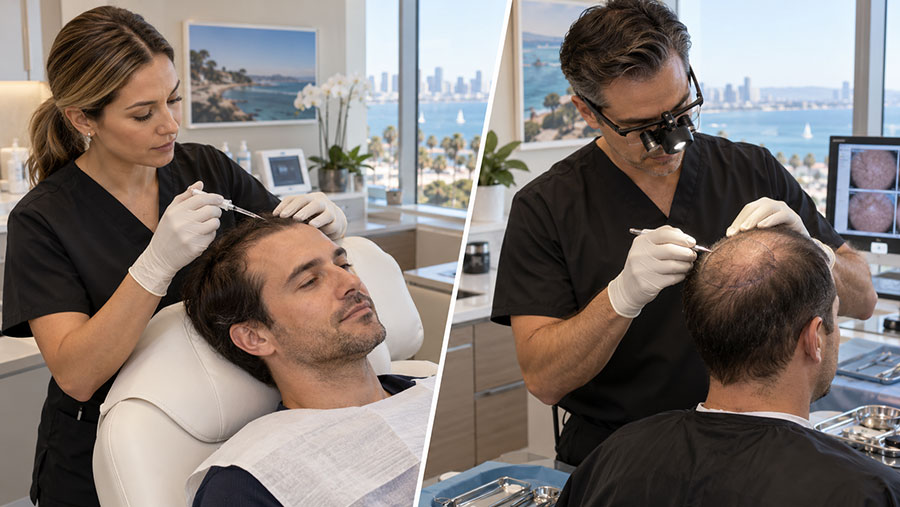
Stem cell hair restoration and hair transplant surgery take different approaches to addressing hair loss. Compare how each procedure works, who may qualify, expected recovery, potential outcomes, and important limitations. This guide can help you prepare for an informed conversation with a qualified provider about which option may align with your hair goals
Patients evaluating stem cell hair restoration vs. hair transplant face a choice between surgical redistribution and non-surgical regenerative support. Hair transplant surgery moves healthy follicles from donor areas to thinning or balding zones, while stem cell restoration uses regenerative signals to support dormant follicles and encourage natural hair renewal. Which one delivers stronger results cannot be answered universally, because each treatment serves a different candidacy profile, hair-loss pattern, and set of patient priorities.
Below, you’ll find a side-by-side comparison of how each treatment works, who qualifies, how long results take, what the safety and FDA picture looks like, and which alternatives are worth weighing. Confidence-driven professionals researching hair restoration in San Diego tend to prioritize natural-looking outcomes, minimal downtime, and science-backed methods that fit a full schedule, which is how our La Jolla specialists frame every consultation. The right choice depends on whether you need follicle relocation for advanced pattern baldness or regenerative support for early-to-moderate thinning.
Key Takeaways
- Hair transplant surgery can be effective and permanent for pattern baldness candidates with sufficient donor hair, according to the American Academy of Dermatology.
- Stem cell hair restoration is positioned as a non-surgical, comfortable option with little to no downtime for early-to-moderate thinning.
- Regenerative hair research shows promise but requires caution until larger studies reproduce findings, according to a 2023 systematic review.
- FDA regulatory guidelines require careful consideration, as many regenerative medicine products have not been shown to be safe or effective.
- Better results depend on candidacy factors including hair-loss stage, donor hair availability, downtime concerns, and willingness to undergo surgery.
Stem Cell Hair Restoration Vs. Hair Transplant: How Each Procedure Works
Hair transplant surgery redistributes healthy follicles from donor areas into thinning or balding zones. Stem cell restoration is a regenerative-support approach that uses biological signals to wake dormant follicles and encourage healthier hair growth.
The difference lies in mechanism and candidacy. A transplant physically relocates follicles, so it applies to defined pattern baldness with enough donor hair. Stem cell restoration targets follicle revitalization, so it applies to thinning hair where viable follicles remain.
| Comparison point | Stem cell hair restoration | Hair transplant |
|---|---|---|
| Method | Regenerative signals support dormant follicles | Surgical relocation of healthy follicles |
| Suited to | Early-to-moderate thinning with viable follicles | Defined pattern baldness with adequate donor hair |
| Surgery | None | Required, including donor-area harvesting |
| Downtime | None; normal activities resume the same day | Healing phase with activity restrictions |
| Result pattern | Gradual density gains over 6 to 12 months | Permanent relocation of transplanted follicles |
| Ongoing care | Repeat sessions may be needed | Native hair may still thin and need treatment |
How Stem Cell Hair Restoration Works
Stem cell and exosome-positioned hair restoration uses regenerative signals derived from stem cells or exosomes to support dormant follicles. This approach aims to encourage healthier density, strand strength, and hair quality through biological communication rather than surgical relocation.
Regenicel Aesthetics offers stem cell hair restoration as a non-surgical, personalized option with little to no downtime. Patients resume normal activities the same day, which suits professionals who cannot schedule surgical recovery.
How Hair Transplant Surgery Works
The American Academy of Dermatology describes hair transplant as moving healthy hairs from one part of the scalp to areas with thinning hair.
Surgeons harvest follicles from the donor area and place them in thinning or bald zones. Those follicles keep growing in their new location, which is what makes the result permanent for suitable candidates.
Intended Outcomes of Each Treatment
Transplanted follicles keep the growth characteristics of the donor area, which gives lasting density in previously thinning zones. The American Academy of Dermatology calls hair transplant an effective and permanent solution for pattern baldness.
Transplanted hair is permanent, but it does not stop non-transplanted hair from thinning. Continued loss in untreated areas can call for further procedures or medical maintenance.
Stem Cell Hair Restoration Vs. Hair Transplant Candidacy Requirements
Candidacy turns on hair-loss pattern, donor hair availability, treatment goals, downtime tolerance, and willingness to have surgery. Transplant serves clear pattern baldness with sufficient donor follicles; stem cell restoration fits early-to-moderate thinning in patients who prefer a non-surgical route.
Preferences around natural-looking improvement and recovery time carry real weight here. The decision needs an honest read on the current hair-loss stage, likely progression, and comfort with surgery.
Patients Who Benefit Most From Stem Cell Hair Restoration
Stem cell restoration is most relevant for thinning, shedding, and early-to-moderate density concerns, not large areas with no viable follicles. Hair transplant addresses clear pattern baldness with enough donor hair, while stem cell restoration suits early-to-moderate thinning.
Hair transplant suits patients comfortable with surgery and donor-area harvesting. Stem cell restoration serves those who want minimal disruption and gradual, natural-looking improvement.
Candidates Typically Recommended for Hair Transplant Surgery
Hair transplant candidacy depends on donor hair availability, the pattern of loss, overall health, and realistic expectations. Adequate donor hair matters because the procedure redistributes existing follicles rather than creating new ones.
Ideal candidates have stable pattern baldness with clearly defined areas for transplantation. Surgery involves recovery time, the possibility of multiple sessions, and ongoing maintenance of non-transplanted hair, which is why a personalized consultation should come before any decision.
Donor Hair Availability and Candidacy
Hair transplant depends on donor hair availability and the pattern of loss. The International Society of Hair Restoration Surgery reports an average of 2,347 grafts in a first session to reach the desired result.
The same ISHRS data shows 1.5 surgical procedures per patient to reach the desired result. Many patients therefore need more than one session, which makes donor reserves a critical candidacy factor.
Treatment Timelines and Recovery Compared
Timelines and recovery differ sharply between surgical redistribution and non-surgical regenerative support. A transplant involves healing and progressive growth; stem cell restoration allows an immediate return to activity with gradual improvement.
Both approaches ask for patience. Knowing the realistic timeline up front helps you pick the treatment that fits your schedule.
| Stage | Stem cell hair restoration | Hair transplant |
|---|---|---|
| Immediately after | Normal activities resume the same day | Recovery period with limits on exercise, sun, and scalp contact |
| First 1 to 3 months | Early changes in shedding and hair quality | Transplanted hairs shed before regrowth starts |
| 6 to 9 months | Average point for visible density improvement | Growth becomes noticeable in treated zones |
| 12 months | Fuller results, with improvement still possible | Final density from the session is apparent |
| Session count | Series of three, about one month apart | ISHRS reports an average of 1.5 procedures per patient |
Expected Timeline for Stem Cell Hair Restoration Results
Some patients notice improvements within a few months, with an average expectation of 6 to 9 months and fuller results at 12 months. Improvements may continue across 6 to 12 months as follicles respond to regenerative signals and strengthen.
Most clients complete a series of three treatments spaced about one month apart. The same cadence applies to exosome therapy protocols, which spread regenerative support across several weeks while keeping each visit short.
Hair Transplant Recovery Time
Hair transplant requires surgical recovery, with restrictions on physical activity, sun exposure, and scalp manipulation during healing. Regenicel Aesthetics reports no downtime for stem cell restoration, so patients return to normal activities the same day.
Transplanted hair usually sheds within weeks before new growth begins. Full transplant results also unfold over months as relocated follicles settle into new growth cycles.
Maintenance Required After Each Procedure
Transplant patients may still need maintenance for native hair that keeps thinning. Non-surgical treatments may need repeat sessions to sustain regenerative support for follicle health.
Neither treatment prevents future hair loss in untreated areas. Maintenance plans often combine medical treatment, additional procedures, or a mix of both to protect overall scalp coverage.
Risks, Safety, and FDA Regulatory Considerations
Safety profiles and regulatory status differ between an established surgical procedure and an emerging regenerative one. Hair transplant has a documented procedural history, while stem cell and exosome therapies call for careful reading of evolving research.
Regulatory status matters most for regenerative treatments. Knowing what the FDA has and has not approved, and where current research stops short, keeps expectations realistic.
Current Research on Stem Cell Hair Restoration Safety
A 2023 systematic review of human stem cell use in androgenetic alopecia selected 14 articles. It reported no major side effects in the alopecia patients reviewed, but said the findings should be read with caution until reproduced in larger, more representative samples.
Regenerative and stem cell approaches for androgenetic alopecia have promising early evidence but still need caution until larger studies reproduce the findings. Our treatment FAQ covers how we set expectations around that evidence before anyone books.
Evidence Supporting Hair Transplant Surgery
The American Academy of Dermatology describes hair transplant as an effective and permanent solution, backed by decades of procedural refinement. In 2024, an ISHRS member treated an average of 156 surgical and 498 non-surgical hair-restoration patients.
That procedural history brings substantial clinical experience and documented outcomes. Hair transplant benefits from standardized techniques, training protocols, and predictable results for suitable candidates.
FDA Regulatory Guidelines for These Treatments
The FDA warns that regenerative medicine products, including stem cell and exosome products, are regulated, and that many marketed products have not been shown to be safe or effective. Generally, all stem cell products require FDA approval.
There are currently no FDA-approved exosome products. The only FDA-approved stem cell products in the United States are blood-forming stem cells from umbilical cord blood, approved for disorders affecting blood production and not for other uses.
Patient Priorities That Shape Treatment Choice
Priorities around downtime, natural appearance, confidence, and daily routine shape treatment selection as much as clinical candidacy does. People researching hair restoration across La Jolla and the San Diego metro area usually want convenience, subtle results, and methods grounded in published science.
Two patients with the same hair-loss pattern often choose differently once scheduled, comfort with surgery, and appetite for maintenance enter the conversation. Naming those priorities early aligns the treatment choice with lifestyle and aesthetic goals.
Downtime and Decision-Making
Surgical recovery takes time away from work, social plans, and exercise during healing. Many professionals cannot absorb that gap without affecting commitments.
Non-surgical options remove recovery restrictions and allow an immediate return to normal activity.
Why Natural-Looking Improvement Matters
Natural-looking results avoid the obvious transplanted appearance that draws attention. Patients who want subtle change prefer gradual improvement that matches their existing hair.
Regenerative approaches build density gradually across months, so hair strengthens and thickens progressively rather than changing overnight. Documented outcomes in our treatment gallery before and after show how that progression looks at three, six, and twelve months.
Confidence and Lifestyle Considerations
Hair loss affects professional confidence and self-image, especially for people whose work depends on a polished appearance. Restoring density can lift confidence in meetings, presentations, and social settings.
Active routines call for treatments that do not interrupt training, travel, or time outdoors. Minimally invasive options with no recovery period fit those schedules.
Alternative Hair Restoration Options to Consider
Several medical and non-surgical alternatives sit between transplant surgery and stem cell restoration. Seeing the full range of hair-loss treatments makes candidacy assessment more useful.
Each option carries its own timeline, maintenance load, and candidacy limits. Combining two or more can work better than any single treatment on its own.
| Option | How it works | Timeline and maintenance |
|---|---|---|
| Minoxidil (topical) | Supports the growth phase of existing follicles | 6 to 12 months to judge; benefits stop when use stops |
| Finasteride (oral) | Targets the hormonal driver of male pattern loss | FDA-approved for male pattern hair loss; ongoing use required |
| PRP injections | Concentrated plasma injected into thinning areas | About 10 minutes per visit; monthly for 3 months, then every 3 to 6 months |
| Low-level laser therapy | Light energy applied to the scalp to support growth | Home or in-office devices; consistent use over time |
| Stem cell and exosome therapy | Regenerative signals wake dormant follicles | Three sessions about a month apart; results build over 6 to 12 months |
Minoxidil and Finasteride Compared
Minoxidil usually takes about 6 to 12 months to show results, according to the American Academy of Dermatology. Its benefits are lost once a patient stops applying it, so daily use has to continue indefinitely.
Minoxidil cannot regrow an entire head of hair, though it can help with early loss. Finasteride is FDA-approved for male pattern hair loss and also requires ongoing use.
PRP Therapy for Hair Loss
PRP for hair loss involves drawing blood, separating the plasma, and injecting it into thinning areas. The procedure takes about 10 minutes and usually requires no downtime, according to the American Academy of Dermatology.
PRP patients often return once a month for three months, then once every three to six months.
Laser Therapy as a Complementary Approach
Low-level laser therapy may support hair growth, particularly for patients who dislike daily medication. Devices exist for home use and for in-office treatment.
Studies suggest laser therapy can improve density when used consistently. It works as a complement rather than a standalone fix.
Choosing Between Stem Cell Hair Restoration and Hair Transplant
Deciding well means assessing hair-loss stage, donor hair availability, timeline expectations, and risk tolerance together. A consultation allows that assessment against your actual scalp rather than a general profile.
Ask for an honest conversation about goals, limits, and realistic outcomes. The long-term effects of stem cell therapy are still being studied, while hair transplant offers established permanence for relocated follicles.
Questions to Ask During a Consultation
Useful questions cover candidacy criteria, expected timelines, maintenance, and realistic outcomes for your specific pattern of loss. Knowing what a treatment cannot do prevents disappointment later.
Questions about safety, regulatory status, and provider experience help you judge credibility. You should feel comfortable asking for clarification on any part of a proposed plan before agreeing to it.
Goals, Timeline, and Risk Tolerance
Treatment goals decide whether follicle redistribution or regenerative support serves you better. Timeline tolerance decides whether you prefer gradual natural improvement or are willing to wait through surgical recovery and regrowth.
Risk tolerance shapes comfort with surgery versus non-surgical care. Patients averse to surgery often accept maintenance sessions in exchange, while those who want permanent redistribution accept the surgical risks.
Combination and Sequential Treatment Options
Some patients use regenerative support before or after surgery to protect overall scalp health. Sequential treatment can address early thinning first and hold surgery in reserve for advanced pattern baldness.
Combination plans may pair medical maintenance with procedural treatment. That approach addresses several drivers of hair loss at once and protects both transplanted and native follicles.
Assessing Results in Stem Cell Hair Restoration vs. Hair Transplant
Which treatment produces stronger results depends on candidacy, goals, and priorities rather than any universal ranking. Hair transplant delivers permanent follicle redistribution for pattern baldness with adequate donor hair, while stem cell restoration offers non-surgical regenerative support for early-to-moderate thinning.
Patients who want surgical permanence and accept recovery often land on hair transplant. Those who prioritize non-surgical convenience, no downtime, and gradual natural improvement often prefer stem cell Biologics hair restoration. The right choice matches the treatment mechanism to your hair-loss stage, lifestyle, and aesthetic goals.
For candidates exploring non-surgical options beyond the scalp, the same regenerative techniques apply to stem cell IV infusions.
Talk With Regenicel Aesthetics About Your Hair Restoration Plan
Regenicel Aesthetics provides personalized regenerative treatments that support natural hair renewal with minimal disruption to your routine. Our specialists work out of the La Jolla Wellness Center and build every plan around your hair-loss stage, your schedule, and what a realistic result looks like for you.
Book a complimentary consultation through our online scheduling page, call +1 858-758-1573, or reach the team through our contact page. We will assess your scalp, explain what stem cell hair restoration can and cannot do in your case, and give you a written quote before you commit to anything. Find us at the La Jolla Wellness Center, 8950 Villa La Jolla Suite B115, La Jolla, CA 92037.
Frequently Asked Questions About Hair Restoration
Neither treatment wins in every case. Hair transplant delivers permanent follicle redistribution and suits defined pattern baldness with enough donor hair, while stem cell hair restoration supports dormant follicles in early-to-moderate thinning without surgery. The answer for you depends on hair-loss stage, donor supply, and recovery tolerance.
Both treatments are quoted after an in-person assessment, because cost tracks the size of the treatment area and the number of sessions. A hair transplant is usually one larger surgical fee, and industry data shows an average of 1.5 procedures per patient to reach the desired result. Stem cell hair restoration is normally quoted as a series of three sessions about a month apart. Call Regenicel Aesthetics at +1 858-758-1573 for your own quote.
Yes, and sequential treatment is common. Some patients use regenerative support before surgery to improve scalp condition, or after surgery to support both transplanted and native follicles. Others treat early thinning regeneratively and hold surgery in reserve if the pattern advances. A specialist should map the sequence so the two treatments do not overlap in a way that disrupts healing.
No exosome products currently hold FDA approval. The only FDA-approved stem cell products in the United States are blood-forming stem cells from umbilical cord blood, used for disorders affecting blood production. The FDA has warned that many marketed regenerative medicine products have not been shown to be safe or effective. Ask any provider to explain the regulatory status of the product they use before you agree to treatment.
Transplanted follicles keep the growth characteristics of the donor area and are considered permanent in their new location. Stem cell hair restoration produces improvements that build across 6 to 12 months and may need maintenance sessions to sustain follicle support. Neither treatment stops thinning in untreated areas, so plan for some ongoing maintenance either way.